


How did you start to write Making Headlines?
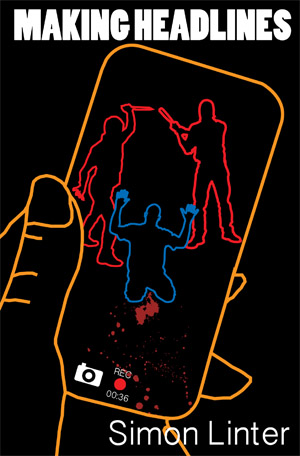 When I studied Media in the 1990s, part of the course included writing scripts for potential television shows. I liked this format so much that I started writing a script based on an idea I had. When I had finished it (in 1994), it was roughly 90 pages long, called Stealth, and in all honesty wasn’t very good. I didn’t know what to do with it so I shelved it away until 1998 when I rewrote the script and updated it. I sent it out to several film producers and got a reply from two based in the US, one of which I later met in The Groucho Club in London. This meeting did not lead to anything other than a trip to London and meeting a happy-go-lucky film producer, and this also meant that I still had a manuscript that I didn’t know what to do with. In 2013 I signed up for a course on creative writing at Folkuniversitetet in Stockholm and dredged up my script called Stealth but renamed it Making Headlines. I started to write a few chapters and other participants on the course wanted to know what happened next, which forced me into writing the first draft in novel format. After this, I then wrote draft 2 and sent it off to an editor who came back with suggestions. I then wrote draft 3, which is the final version that I released. So all in all I wrote 5 drafts of Making Headlines and it was released in 2015, 20 years after I had first attempted to write it as a film screenplay.
 I aimed for A Decade in Sweden to be released on the 23rd November 2013 because that would have been exactly ten years to the day that I moved from the UK to Sweden. However, as the book wasn’t near completion near the deadline, I rushed to get it finished. This caused a number of mistakes to be made including not fully proofreading the finished manuscript, not obtaining my own ISBN, etc. The same can be said of Making Headlines although I didn’t impose a deadline on that project. The mistakes made in that book were just caused through complacency. These books were always going to be experimental in terms of me gaining experience in releasing books into the cosmos. In this respect, I gained a lot of valuable experience and learnt a lot of lessons. As an editor said to me: “you have to slow down a bit”, and I have taken this advice on-board and am more vigilant going forwards with new projects.
 When writing a non-fiction book, it is always worth checking whether publishers or agents are interested at the idea stage. I had written a first draft of A Decade in Sweden when I sent out submission letters to agents. I first concentrated my quest for an agent in Sweden and found that there aren’t many agents around. However, I did get one bite from an agent who really liked the book. Unfortunately, that agent left their job and I had to start my hunt over. I sent the book to a handful of agents in the UK and got a similar response from an agent in London. On this occasion, although they liked the book and found it interesting, they said it was aimed at a niche market and wouldn’t sell in the quantities that they would like. Again, I was back to square one again. As A Decade in Sweden was my first attempt at a book launch, I looked into self-publishing as a way forward. I looked into distributors online and choose one that I thought was the best at the time. I released the eBook first through BookBaby without checking all my options including getting my own ISBNs. When I decided to print the book, I looked around for the best price vs. a good product. I eventually found
  I moved to Sweden in 2003 and was asked many questions by friends and relatives about what it was like to live here. So in 2006 I wrote an article called An Englishman in Little London for the Monthly magazine in Gothenburg about some of the experiences I had encountered, and to answer some of the questions folk back in the UK were asking. I then started to write the book from a first person perspective about my day-to-day life from 2003 onwards, but it didn’t work. I then decided to write it as a scrapbook of experiences that I had had and this seemed to work better. Of course, some of the events have been exaggerated for effect, and there are some errors and old information that only an edited and revised version can correct. This also raises the question if the book can be called non-fiction if some of the events have been slightly altered. Despite this, the events of the book did and do happen, and nothing written in the book is intended to be insulting towards the UK or Sweden. It’s simply a book about how I live now compared to how I lived then.